


Climate Solutions:
- We Are 2° from Disaster: How to Turn it Around
- Share

Rising sea levels threaten the tiny Pacific Island nation of Tuvalu, inhabited by Polynesians for 3,000 years. Tuvalu residents now face a drowning country.
Photo by Gary Braasch
We Are 2° from Disaster: How to Turn it Around
A 2-degree rise in temperature is the most the Earth can tolerate without dangerous climate change, scientists tell us.
 Why you can trust us
3 MIN READ
Jan 30, 2008
Can we keep climate change from spiraling out of control? The answer, by the numbers.
A 2-degree rise in temperature is the most the Earth can tolerate without dangerous climate change, scientists tell us. The International Panel on Climate Change says that as temperature rises, these effects will kick in:
Today
- Increasing illness and death from heat waves, floods, drought
- Hundreds of millions of people lack drinking water
- Weather changes shift species’ ranges
- Increased wildfires
1°
- Grain production decreasing in low latitudes
- 30 percent of species at increased extinction risk
- Increasing malnutrition, waterborne disease, & infectious disease
- Change in range of mosquitos and other disease vectors
2°
Thresholds of Dangerous Climate Change
- 15% of ecosystems affected, changing biological sinks to carbon sources
- Coastal flooding
- Corals bleached
- Ecosystems disrupted by weakening of “ocean conveyor” system
3°
- 30% of coastal wetlands lost
- Widespread death of coral reefs
- Grain production decreasing
- Substantial burden on worldwide health services
4°
- Significant extinctions worldwide
- All grain production decreases
- 40% of ecosystems affected; “sink to source” changes accelerate
Here’s What We Can Do
Act Quickly
The green line is the familiar goal: 80 percent CO2 reduction by 2050. If we get there, we’re climate cool, right? Actually, if we follow that course, we have a 50 percent chance—a coin toss—of staying within the 2 degrees the IPCC says is the critical range. The sooner we start and the faster we decrease CO2 emissions, the better our odds.
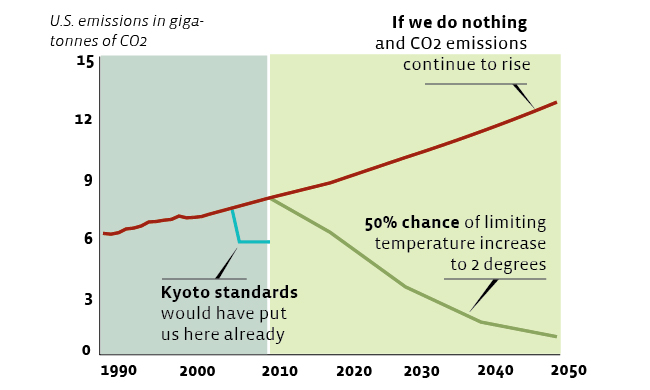
Source: Blair Henry, Climate Change: Playing to Win
Protect Biological Sinks
One of the biggest threats to the Earth’s ability to soak up CO2 is deforestation, especially loss of rainforests. Think deforestation is caused by poor practices in the developing world?
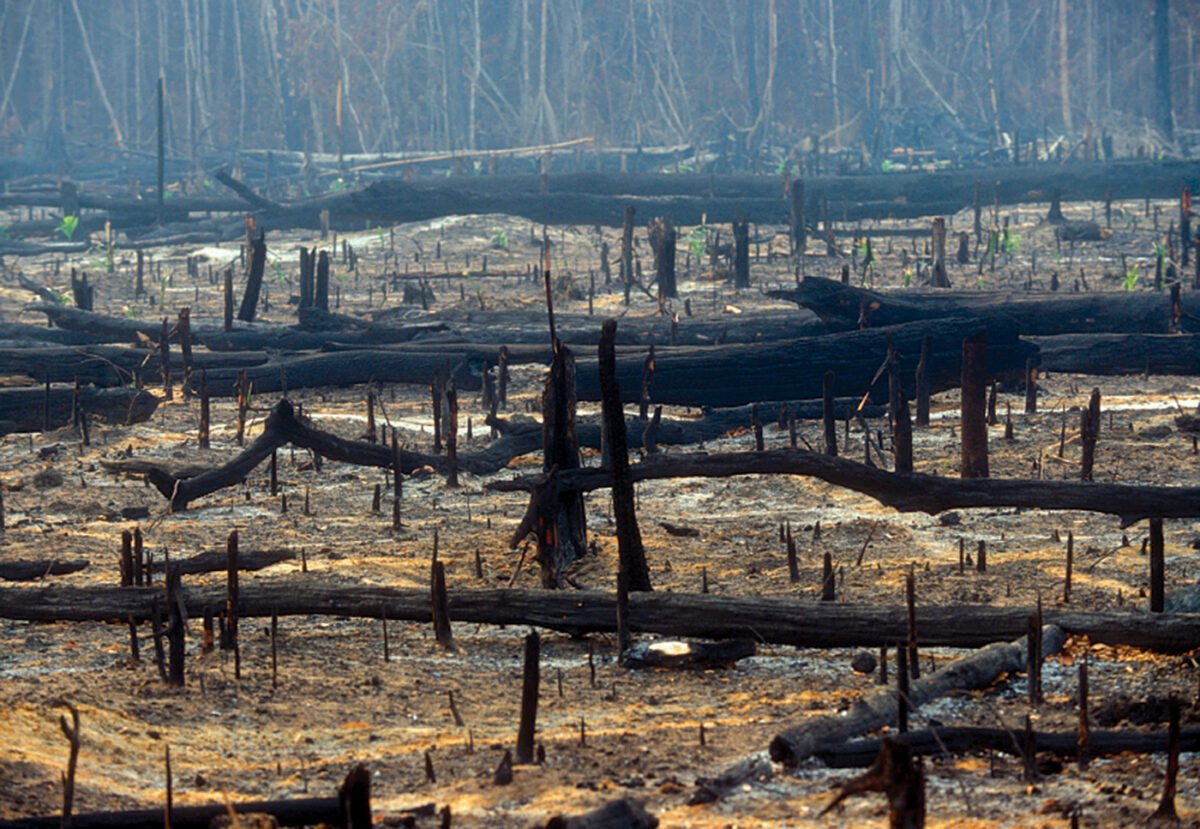
Deforestation in Brasil. Photo from Brasil2/I-S.
Indonesia and Malaysia are slashing rainforest to make palm oil plantations. But they export most of their palm oil to the European Union, China, Russia, and the U.S.—traditionally for food, but increasingly for biodiesel. Brazil is also carving cattle pasture and sugar cane fields out of the rainforest. It’s the world’s No. 1 exporter of beef, feeding the EU, Hong Kong, and the U.S., and aims to double production of sugar cane ethanol, to sell to the U.S. and other countries.
What’s the key to stopping deforestation? Getting the developed world to leave resources where they are, for use by locals.
Zero-Carbon Electricity
Arjun Makhijani has been thinking about cleaner, more efficient energy for more than 35 years. When he heard that we need to go fossil-carbon free by 2050, he doubted it was possible. Research changed his mind, and his book, Carbon-Free and Nuclear-Free: A Roadmap for U.S. Energy Policy, tells exactly how it can be done. Here’s how Makhijani sees the energy supply changing for buildings, transportation and electricity. Makhijani’s plan relies in part on biofuel from algae . Guy Dauncey says we can go carbon neutral with clean electricity . There’s no single path, other than the path that starts right now.
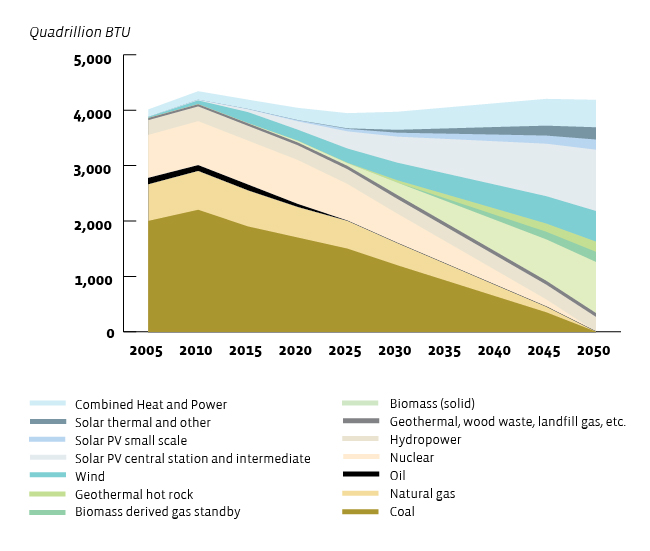
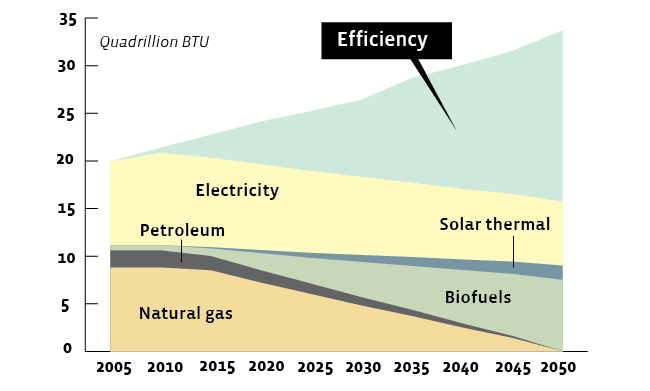
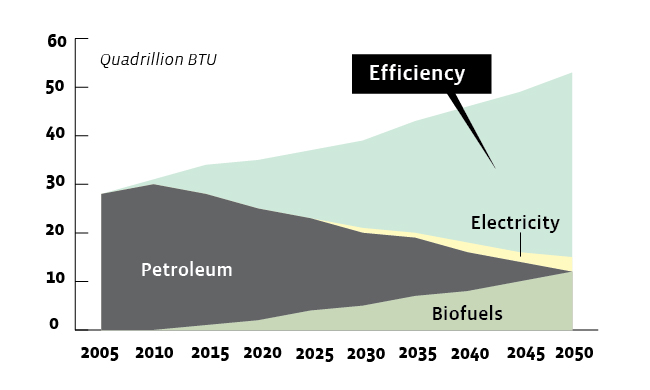
Source: Institute for Energy and Environmental Research

|
Madeline Ostrander is a freelance science and environment journalist based in Seattle.
|

|
Doug Pibel is a former attorney and former YES! editor.
|