
Opinion Advocates for ideas and draws conclusions based on the author/producer’s interpretation of facts and data.
The Fight Against Big Tech’s AI Takeover Must Continue Past the Midterms
 Why you can trust us
Nov 7, 2026 
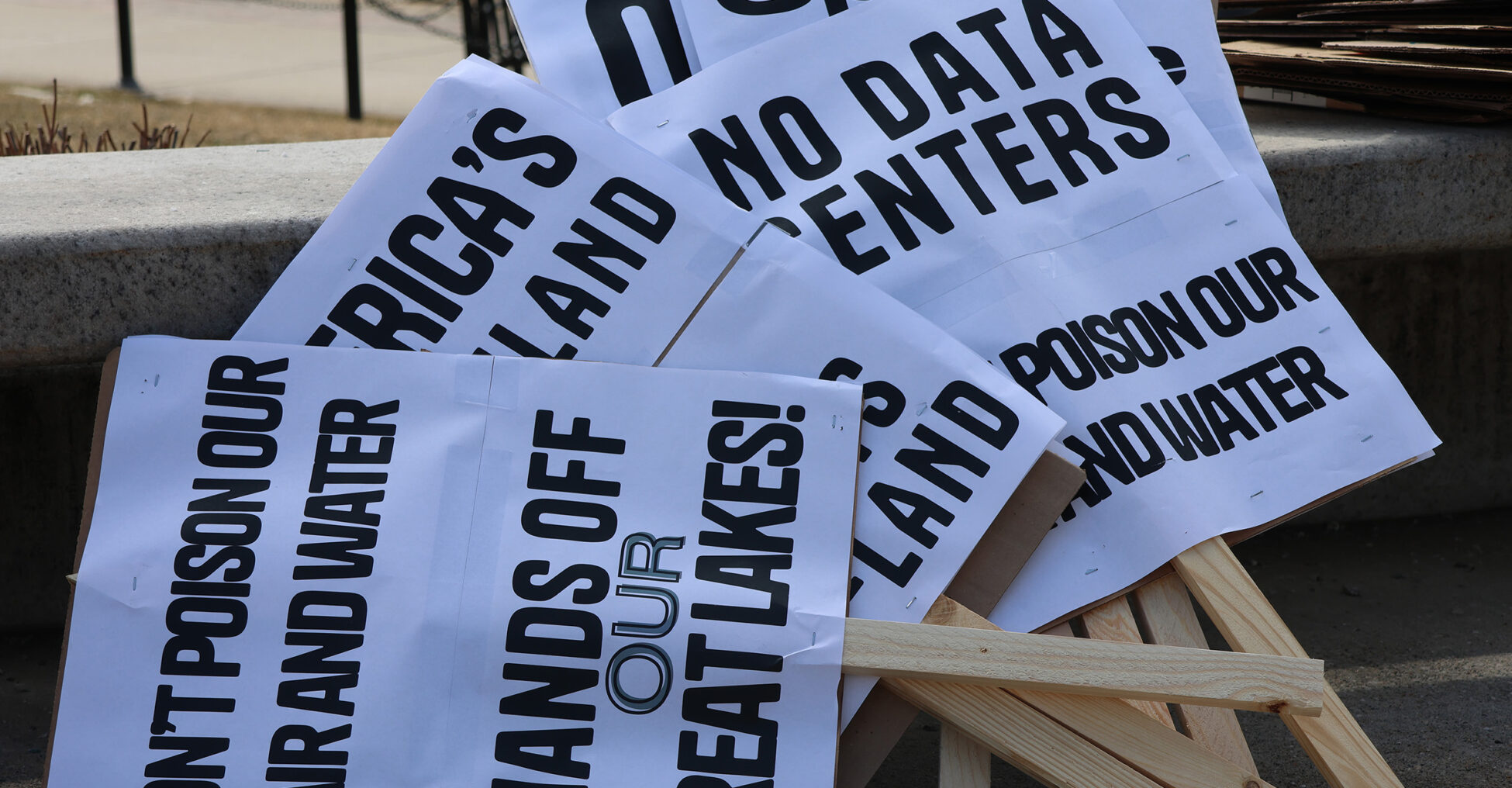
Signs from a "Day of Action" protest against data centers at the Wisconsin state capitol, February 12, 2026.
Since taking front row seats at Donald Trump’s second inauguration in January 2025, Big Tech companies led by Elon Musk, Jeff Bezos, Mark Zuckerberg, and others have accumulated more profits and political power than they have ever before enjoyed. However, as Big Tech has sought to impose AI technology onto U.S. communities, often without consent, masses of Americans have risen to challenge AI data centers, Flock cameras, and the narratives of inevitability that companies such as OpenAI, Meta, and Anthropic have been selling Wall Street and the public.
While mainstream media have framed the fight against AI as a midterms issue, this opposition is more broadly symbolic of a burgeoning popular struggle against tech oligarchical power. Gil Durán, author of The Nerd Reich: Silicon Valley Fascism and the War on Democracy, laid out the stakes for resistance to AI in the midterms and beyond, telling me: “There’s a question about whether we will continue to go in the direction of pumping massive amounts of money into a business model that promises to make a handful of billionaire oligarchs infinitely more powerful than anyone in society.”
In essence, Durán’s comments raise the question: Can workers and communities build a movement to take control over the development and application of technology in a manner that directs it toward socially useful goals instead of its current profit-motivated applications in military technology, policing and surveillance, and worker exploitation? This is the question that opposition to AI data centers, automated license plate readers (ALPRs), and large language models (LLMs) must address following the midterms. This movement must go beyond opposition and begin articulating a broader vision for society that counters what linguist Emily M. Bender and sociologist Alex Hanna call “AI Hype,” while also building a program aimed at finally democratizing technology.
This story is part of the series Taking Back the Public Commons.
Of course, popular movements seeking to democratize the development and application of technology in workplaces and in society stretch back centuries, from the Luddites and the Chartists, to the Mine Wars in West Virginia, to the sit-down strikes for industrial democracy in auto factories in the 1930s. Yet while workers, labor unions, and communities fought for control over technology and production in the first half of the 20th century, labor leaders like the United Auto Workers’ Walter Reuther struck a bargain with management — workers would deemphasize control over new technology in exchange for regular wage and benefit increases and employer-funded pensions.
Yet, amid reports of tech companies striking secret deals with municipalities to build AI data centers, working with law enforcement to install invasive Flock cameras and other ALPRs, and seeking to develop AI “agents” designed to displace workers, the struggle against the U.S.’s tech oligarchy presents another conjuncture where asserting a 21st-century vision for democratizing automation and the economy is paramount. Chicago-based activist and literary scholar Anna Kornbluh spoke with me about how vital this fight is, saying: “Everything is connected to it [AI] — health care surveillance, education, work, finances, our retirement. Everything. And democratic deliberation of what our money is for, and whether we’re going to bail these guys out [if the AI bubble bursts] is the political question that will affect everything.”
So, what could economic democracy look like in the context of forms of artificial intelligence that may, at least according to tech companies, be rapidly developing?
First, according to Durán, it is important for us to take control of this technology out of the private sector. The federal government, he told Truthout, should direct and regulate the development of AI: “Sam Altman and others like to compare AI to the Manhattan Project, but we would not have let private companies develop nuclear bombs on their own and sell them to whoever they wanted. So, if the technology is just as powerful and dangerous, [then] private companies should not be in charge of it,” he said. This argument, however, requires believing the AI industry’s hype — and its repeated threats about doomsday scenarios. Durán also recognizes that such an arrangement could be problematic if another far right president retakes the White House.
Kornbluh also argues for a longstanding progressive demand: taxing Big Tech. “Those people could pay taxes,” she asserted. Forcing corporations and billionaires to pay their fair share after decades of regressive tax policy could cut into their ability to buy off elected officials. Some have also suggested compelling governments to tax AI “agents” and tokens that might be used to put workers out of their jobs. These revenues could go toward worker and community funds that allow for needed investment in public services, goods, and jobs.
Data & Society’s Maia Woluchem and Livia Garofalo, two of the co-authors of a study of anti-AI movements in Pennsylvania, agree that regulating AI companies is important. However, Garofalo questioned the possibilities of regulating the technology after the corporations behind it have grown so powerful. She told me in an interview, “It’s also hard to think about a democratic way to regulate something that is so corporate.”
The workplace has always been the site where people have tried directly exerting control over technology in the private sector. Former Kickstarter worker Clarissa Redwine explains the importance of a workers’ movement against AI far beyond the midterms. As she and JS Tan detail in their book, Against Tech Oligarchy: Worker Resistance in the World’s Most Powerful Industry, Kickstarter workers successfully won a new contract that helped establish a minimum salary and that retained their four-day workweek. However, according to Redwine, “[The workers] had been out for so long that it gave management time to play around with artificial intelligence in their effort to retool the workplace.” Consequently, Redwine said, “They ended up replacing quite a bit of work … They had mass layoffs.”
As a recent ABC/Washington Post/Ipsos poll demonstrates, nearly two-thirds of Americans are anxious about AI taking their jobs, especially at a time of rising inflation and cost of living. The SAG-AFTRA and Writers Guild of America’s strikes in 2023 offer a model for collective action to protect workers from an AI takeover. All three strikes won legal protections against automation, such as forbidding studios from replacing human actors with “digital replicas” without consent or using AI to write “source materials.” Likewise, members of the Directors Guild of America pushed studios to declare that “AI cannot replace the duties performed by members”; in other words, employers could not replace human directors with AI.
Union scrutiny and organizing around AI not only provides a check against employer and government attempts to use it to discipline and fire workers, but it can also form a basis for communities outside of the tech industry to demand more control of automation. Because, as Redwine emphasized, “It’s not that people necessarily hate technology. They hate how technology is being used. [They hate the] exploitative nature of how technology is being employed across society.” Ultimately, as David Noble, a historian of automation, wrote in a 1984 issue of Dollars & Sense, “These technologies are not eternal — they reflect the interests of one class.”
It is going to take a robust and enduring anti-corporate movement to win regulatory policy, tax fairness, and worker control. However, as anti-AI movements in states like Utah, New Jersey, Virginia, and Pennsylvania demonstrate, grassroots opposition to AI data centers, ALPRs, immigration jails, and other uses of artificial intelligence will also need to continue to hold policymakers and corporations accountable after the midterms.
Data & Society’s report, “The AI Factory: Data Centers, Power, and Resistance in Late Industrial Pennsylvania,” offers strategic possibilities for the development of the anti-AI movement. In this robust document, Maia Woluchem, Livia Garofalo, Ana Carolina De Assis Nunes, Joan Mukogsi, and Cella Sum detail a range of tactics for local and state-based movements in their report on Pennsylvanians’ opposition to Big Tech and their narratives of technological determinism.
According to the report’s authors, Pennsylvanians from various preexisting activist groups have joined with residents to combat an expansive pro-AI coalition that includes companies like Amazon and Microsoft, Gov. Josh Shapiro, private developers, and other AI boosters. Data & Society found that opposition worked best when coalitions of groups concerned about the environment, immigration, energy, and extractive capitalism came together around data centers as a focal point for action. To echo Anna Kornbluh’s words, the AI fight is connected to everything.
In addition to fighting the AI tech oligarchy, we must articulate a different vision of society that centers workers and communities controlling and democratizing technology.
The authors of “The AI Factory” outline three strategies for organizing and building opposition to AI over the long-term — myth-busting, “unveiling networks of power and collusion,” and tracing data centers. Myth-busting entails combating the pro-AI coalition’s narrative that Pennsylvania represented an “AI Factory” and that the massive buildout of infrastructure would return the state to its prior industrial glory. However, like in other states with grassroots opposition, the pro-AI faction’s narrative strategy is failing. Woluchem said this is due in part to continued government disinvestment from “the systems that we know create some semblance of a sense of dignity” and public awareness that “technology is not providing any systemic answers to huge systemic problems.”
In the next strategy, uncovering power networks and public-private collusion, the opposition seeks to reveal how developers and tech companies secure secret deals with municipalities to build AI infrastructure. Corporations and developers have relied on secrecy, whether through non-disclosure agreements or clandestine communication, to secure public resources and land, which has driven the rise in community and worker distrust of AI. Echoing old “right to know” campaigns organized by anti-corporate and environmental justice activists, the authors of “The AI Factory” detail how groups like the Concerned Citizens of Montour County filed right-to-know requests to access Amazon AWS’s emails to the governor’s office about local opposition to their proposed developments and threats to abandon projects in the state.
In the last strategy, Pennsylvanians have mapped data center proposals and development. The nonprofit research and policy institute Data & Society detailed one former resident’s efforts to track data centers. She built a multi-layered map of infrastructure. “Next, she added power stations, substation locations, and power lines. She started to track proposals in the whole state. By connecting publicly available data gathered through Wikipedia and government websites … and FOIA requests, she has expanded the work to other states outside Pennsylvania.”
Data center mapping also uncovers public-private collusion in the building of AI infrastructure, which provides concerned citizens with a picture of where and why data centers are located in particular areas. This tracking also allows organizers and residents to plan collective responses.
Woluchem and Garofalo also explained other democratic alternatives to the large, environmentally damaging AI systems. Woluchem pointed to how some computer scientists might create and use smaller open-source language models that tax natural resources less than ChatGPT and Claude. However, scientists and engineers would have to find ways to develop these models independently, without taking funding from tech companies like OpenAI and Anthropic. Could smaller, publicly owned options for generative AI exist and flourish in a renewed age of corporate consolidation and capitalist-driven AI hype? One could imagine that such models might be able to emerge if these expressions of popular opposition build enough leverage to extract resources from large corporations and the 1 percent.
As the midterm elections pass, it is important that the nationwide opposition to AI development conceive of a democratic and, as Durán emphasized, positive vision for the future. One of the problems that Durán, Woluchem and Garofalo, Redwine, and Kornbluh all identified with the current political landscape is that tech billionaires and their companies are the ones dictating the terms of the conversation about AI and the future. The tech industry’s vacillation between utopian and apocalyptic forecasts leave people confused, according to Garofalo. “So, it’s either going to replace all our jobs so we can be on UBI [Universal Basic Income], or we’re extinct?” Even more disturbingly, as Durán told Tech Policy Press in a recent interview, the tech oligarchs have monopolized a vision of the future with AI, and “It doesn’t involve us.”
A true victory over the AI industry will require mass protest and collective action — paired with a compelling vision for a different future.
In addition to fighting the AI tech oligarchy, we must articulate a different vision of society that centers workers and communities controlling and democratizing technology. A more humane and environmentally just vision could arise from a multitude of local and state-based sources, from communally researching and engaging technology to advocating for states and municipalities to commit to full transparency and open public hearings so all who are interested can participate in the decision-making process for new infrastructure development.
People can also start utilizing some of the organizing strategies that Garofalo, Woluchem, and their research team at Data & Society outlined in their report. Labor unions can learn from the examples of tech and culture worker organizers like those at Kickstarter, Twitter (before Elon Musk took over), and in Hollywood to push for more control over the implementation of automation in their workplaces. Maybe workers could draft another “Workers’ Technology Bill of Rights”?
Whatever the tactics and strategies communities, workers, and activists utilize, Big Tech, billionaires, developers, and elected officials will not allow the democratization or abandonment of AI as long as they see it as the path toward greater profits and the further exploitation of the labor force. A true victory over the AI industry will require mass protest and collective action — paired with a compelling vision for a different future.
This story was co-published with Truthout.


|
Austin C. McCoy
is a scholar of African American history, labor, social movements, and popular culture. He is also the author of Living in a D.A.I.S.Y. Age: The Music, Culture, and World De La Soul Made. Follow him on Bluesky.
|
Reprints and reposts: YES! Magazine encourages you to make free use of this article by taking these easy steps.