Analysis Based on factual reporting, although it incorporates the expertise of the author/producer and may offer interpretations and conclusions.
With Dems on the Rise, Organizers Ramp Up Push for Paid Family and Medical Leave
 Why you can trust us
Nov 17, 2026 
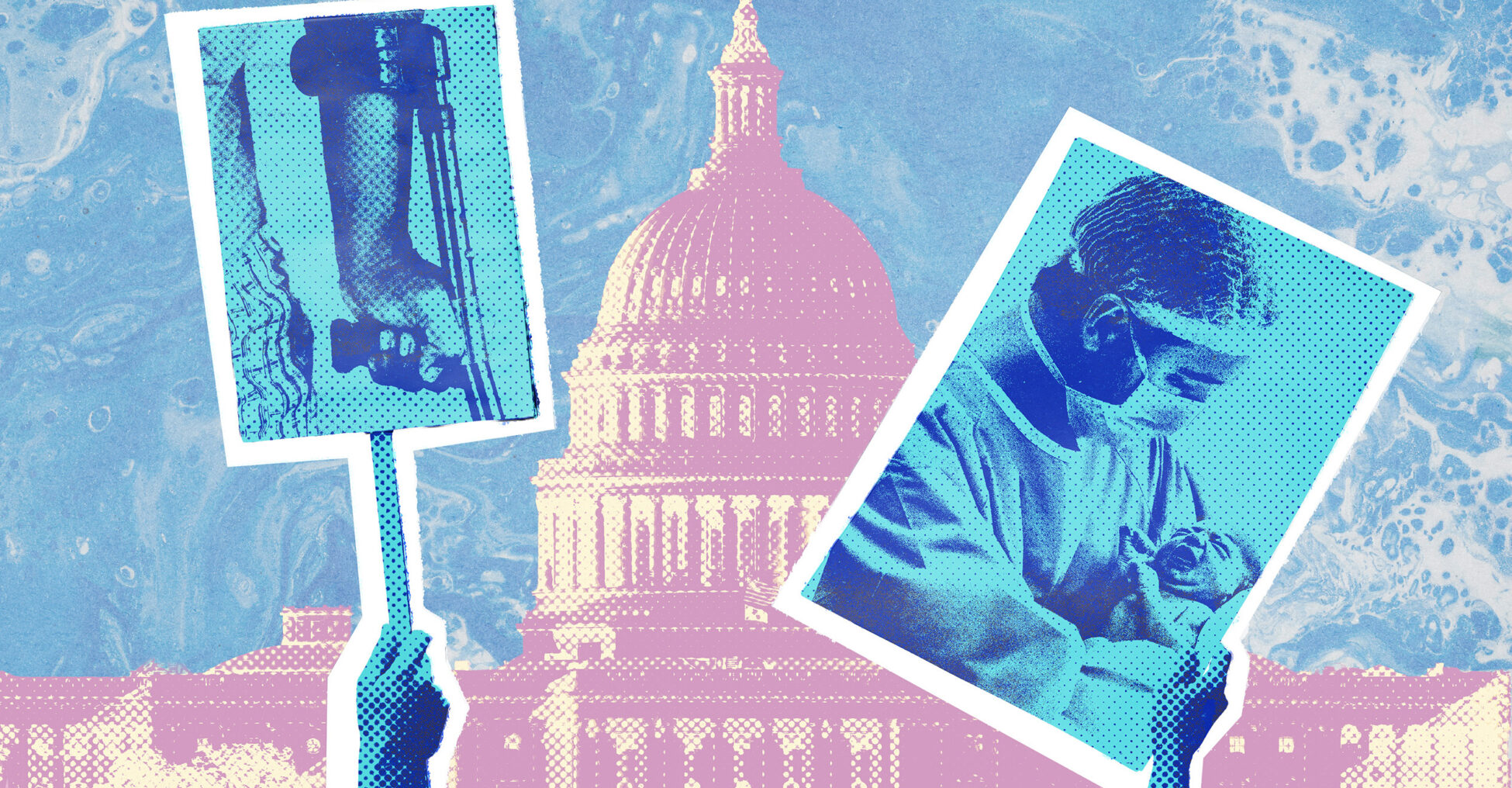
Collage by Jared Rodriguez; Photos via Unsplash
The United States is one of the only nations in the world without a federally guaranteed paid family and medical leave policy. As U.S. workers continue to be caught between stagnant wages and rising costs, a single emergency such as an unexpected illness can put them into the untenable position of choosing between their physical health and their financial health.
In June 2025, Jasmine White of Harrisburg, Pennsylvania, found herself in exactly such a situation when she became injured and unable to walk. The single mother of four had no safety net to sustain her catering business, Jazzy Good Eats & Catering. “I was forced to step away because my body wouldn’t allow me to keep going,” she said. “I didn’t have paid leave, disability coverage, or a safety net to fall back on.”
In the absence of federal action, a state-by-state movement for paid family and medical leave has spent years painstakingly pushing for policy changes — and has enjoyed growing success. According to Paid Leave for All, a nationwide coalition of organizations working on the issue, “fourteen states and the District of Columbia have passed laws to guarantee paid family and medical leave, while 18 states and D.C. along with several municipalities have paid sick time laws.”
This story is part of the series Taking Back the Public Commons.
With Pennsylvania not yet on that list of states, White was forced to take unpaid leave for four months while recuperating from her injury. “When I couldn’t work, the business couldn’t operate the way it needed to,” she said. The resulting financial precarity forced her to pivot her business model from a restaurant and catering operation toward exclusively catering, and she switched from employing full-time employees to hiring contract workers as needed.
“It feels like a never-ending cycle of working just to survive,” said White. “If you don’t work, you don’t eat. If you don’t work, you can’t pay your bills. If you don’t work, your children are affected. That reality keeps me in a constant state of work mode.”
Jennifer Driscoll of Coopersburg, Pennsylvania, experienced a similarly difficult situation when her daughter Lily was born seven weeks premature in 2007 and she needed to stay at home to care for her fragile newborn. “That decision came at a tremendous financial cost to our family,” said Driscoll. “We went into serious debt because of my extended time away from work.”
Driscoll and her husband started a nonprofit called Lily’s Hope Foundation in 2013. In her words, her goal was “to support families facing the unexpected challenges and financial hardships that come with having a premature baby or a child in the NICU.” While the organization has supported thousands of families across the U.S., Driscoll believes that “these families need more than care packages and emergency assistance.” They need state support.
According to Dawn Huckelbridge, founding director of Paid Leave for All, “the United States is one of the only countries in the entire world that doesn’t guarantee any kind of paid leave.” This includes vacation, sick leave, parental leave, or time off to care for an ailing family member.
In stark contrast to workers in the U.S., workers in Europe have a guaranteed right to four weeks of paid vacation, and varied but generous amounts of paid sick leave and parental leave depending on the country where they live.
It isn’t that Americans don’t want paid leave. A large majority of the public supports paid family and medical leave, regardless of political affiliation. “Literally any kind of demographic you could try to poll, a supermajority does support this issue,” said Huckelbridge.
It’s hard to believe that until relatively recently, working Americans didn’t even have the right to take unpaid leave for emergencies. The 1993 Family and Medical Leave Act (FMLA) allowed workers to take up to 12 weeks of unpaid leave per year without the risk of losing their job.
When the COVID-19 pandemic struck in 2020, advocates pushed lawmakers to expand on the FMLA with the passage of the Families First Coronavirus Response Act, enabling eligible workers to access paid leave, and self-employed workers to get tax credits in very specific cases of COVID-19 infections. That law’s paid leave provisions lasted barely a year.
Then, under President Joe Biden and with the backing of Sen. Kirsten Gillibrand (D-New York), advocates worked to include provisions for four weeks of paid leave in the 2021 Build Back Better bill. While the bill passed the House of Representatives, it failed in the Senate by one vote: Sen. Joe Manchin (D-West Virginia) refused to vote for the bill, effectively killing it.
The lack of guaranteed paid leave disproportionately impacts low-income women and people of color. Huckelbridge thinks that part of the reason why the U.S. has no federally guaranteed paid leave is that Congress has historically been white male-dominated. “There’s this bias of people who do less of the caregiving,” she said. “Issues that have disproportionately impacted women and people of color have often been sidelined; they’ve often been sort of cut and compromised because they haven’t been framed as fundamental and economic kitchen table issues, when in fact they are.”
In the wake of Manchin’s exit from politics, and historic Democratic Party congressional wins in the November 2026 midterm elections, Wendy Chun-Hoon, president and executive director of the Center for Law and Social Policy, is optimistic: “With the clear majority in both chambers of Congress, we expect Democrats to move swiftly to show voters ‘message received,’ and focus their first hours and days on advancing paid leave and child care for all,” she said.
Having come within a single vote of winning federally guaranteed paid leave in 2021, the Paid Leave for All coalition is now focused on passing a new bill introduced by Senator Gillibrand called the Family and Medical Insurance Leave (FAMILY) Act. Huckelbridge explained that if it were to pass, the bill would ensure paid leave for things like “serious health events, new babies, injuries, illness [in] your family.”
The question that routinely arises with such safety net proposals is how to pay for them and if businesses would suffer. According to Huckelbridge, “It would be administered by the federal government, it would be funded by the federal government, and it would in that way be very much a business support.”
The funding could come from general revenues or from a modest payroll tax. But, given that big corporations and wealthy individuals continue to be enriched from lower taxation, Huckelbridge suggested one simple funding source could come from “taking taxes from the wealthiest and big corporations to make them pay their fair share.”
When asked about the likelihood that President Donald Trump would veto every piece of Democratic Party-supported legislation landing on his desk, Chun-Hoon said, “If this White House chooses to continue to ignore families’ needs — if they veto paid leave — then Congress will have it ready for the next president to sign it in 2029.”
In the meantime, advocates in Pennsylvania, where there is no statewide paid leave, are continuing to push for legislation. Dan O’Brien, the family economic stability policy director at the Pennsylvania-based organization Children First, has been working on passing a state bill called the Family Care Act.
If passed, that act would establish an insurance fund to cover paid sick leave to recover from major surgery, as well as parental leave for the birth or adoption of a new child, and to care for children recovering from serious illness or for elderly parents needing critical care or rehabilitation.
That bill, which has passed the Pennsylvania House of Representatives, has bipartisan support in the Pennsylvania State Senate but, as of this writing, has not yet been introduced for a vote. O’Brien explained that “[state] senate leadership has decided to side with the big business lobbyists in Harrisburg who have been opposing our efforts.” He is confident that if it is brought to a vote in the state senate, it will pass.
Pennsylvania has traditionally been a politically “purple” state, swinging between support for Democrats and Republicans. O’Brien is hopeful that if Pennsylvania lawmakers pass the Family Care Act, it could be a “blueprint for conservative states and the federal government to do the same.”
Workers like White and Driscoll are among those for whom a paid leave guarantee would offer desperately needed relief. “Paid family and medical leave is about dignity, stability, and the ability to take care of ourselves and the people who depend on us,” said White. “We shouldn’t have to reach a breaking point before we’re allowed to rest.”
Driscoll concurred, saying, “No one should have to choose between being there for their family and being able to pay their bills.”
This story was co-published with Truthout.



|
Sonali Kolhatkar
joined YES! in summer 2021, building on a long and decorated career in broadcast and print journalism. She is an award-winning multimedia journalist, and host and creator of YES! Presents: Rising Up with Sonali, a nationally syndicated television and radio program airing on Free Speech TV and dozens of independent and community radio stations. She is also Senior Correspondent with the Independent Media Institute’s Economy for All project where she writes a weekly column. She is the author of Rising Up: The Power of Narrative in Pursuing Racial Justice (2023) and Bleeding Afghanistan: Washington, Warlords, and the Propaganda of Silence (2005). Her forthcoming book is called Talking About Abolition (Seven Stories Press, 2025). Sonali is co-director of the nonprofit group, Afghan Women’s Mission which she helped to co-found in 2000. She has a Master’s in Astronomy from the University of Hawai’i, and two undergraduate degrees in Physics and Astronomy from the University of Texas at Austin. Sonali reflects on “My Journey From Astrophysicist to Radio Host” in her 2014 TEDx talk of the same name.
|
Reprints and reposts: YES! Magazine encourages you to make free use of this article by taking these easy steps.